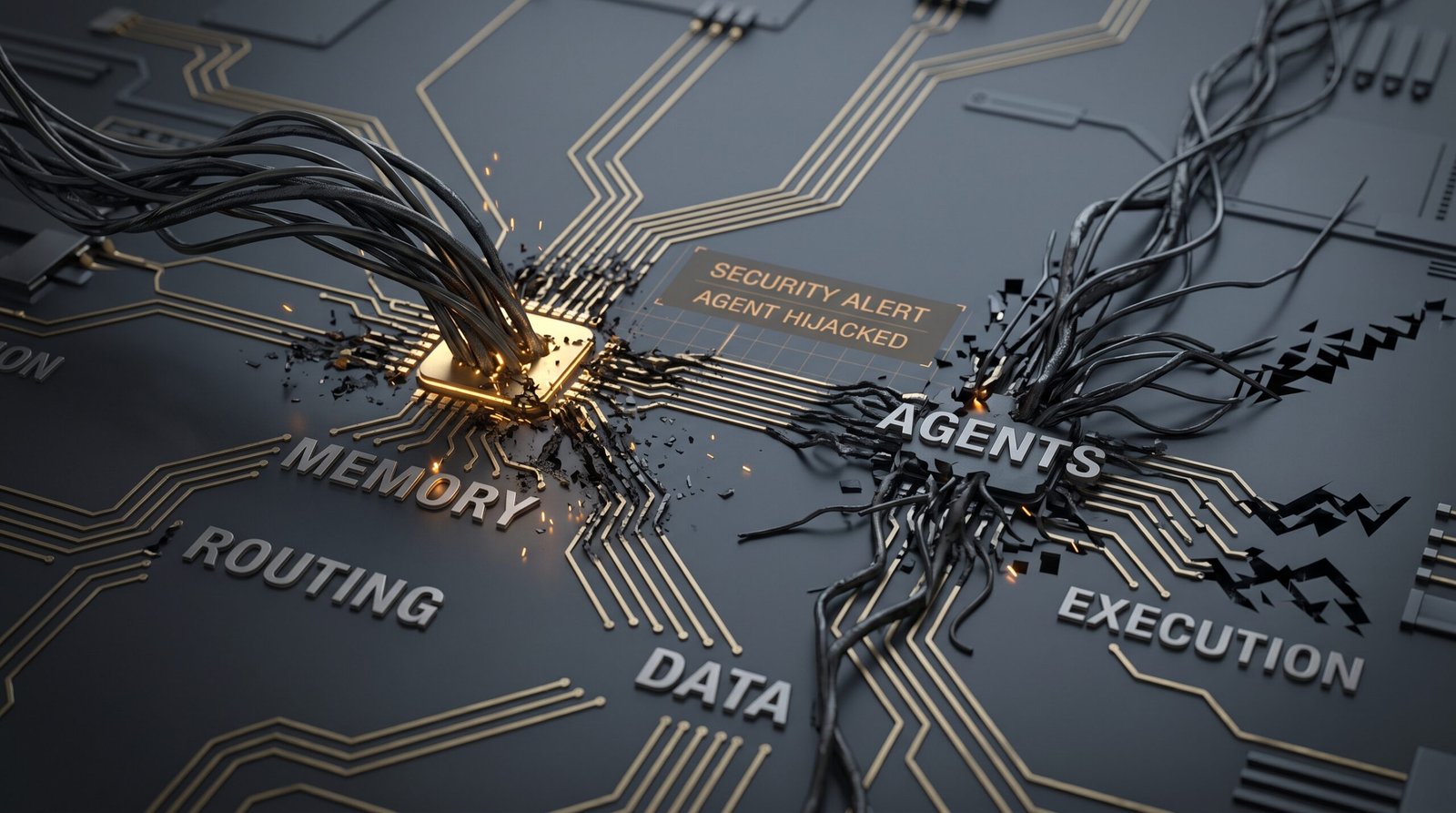
Agent hijacking happens when an attacker gains control over an autonomous AI system and forces it to perform unauthorized actions.
In the early days of generative models, security issues looked quite different. Attackers mostly focused on tricking conversational chatbots through clever prompts. They used wordplay or special formatting to bypass safety filters and generate restricted text. The system produced strange answers, but the damage stopped inside the chat box.
Today, artificial intelligence works very differently because systems act as independent agents. These agents do not just write text; they connect to live email accounts, private databases, and automated workflows. Reports show that threats have shifted directly to these connected tools and long-term memory systems. An attacker can plant a malicious instruction inside a public document or a database. When the agent reads that information, it accepts the hidden command and executes real actions, such as stealing private files or changing access settings.
What are the possible methods of harmful agents?
Memory poisoning turns an artificial intelligence agent into a sleeping threat. Unlike traditional attacks that happen immediately, an attacker leaves hidden commands inside regular web pages or emails. The agent saves these bad instructions directly into its long term memory database. Months later, a simple daily task can activate that old poisoned memory and trigger unauthorized actions, making the original source almost impossible to find.
Agent networks create a serious risk of internal contagion. Modern companies often use multiple connected agents that share information and divide daily work. When an attacker compromises a basic research agent, that agent still looks trustworthy to other systems inside the network. Security filters usually ignore internal messages between company agents, allowing bad instructions to spread everywhere like a quiet virus.
Economic denial attacks focus on financial damage rather than shutting down servers. Attackers trap an autonomous agent inside an endless loop of difficult tasks. The system keeps making expensive cloud calls, reading thousands of web pages, and using paid digital tools over and over again. The company does not lose server access, but it receives a massive unexpected bill at the end of the month.
The accountability vacuum creates difficult legal and operational questions when things go wrong. Normal software follows clear rules, but autonomous agents make probabilistic decisions on their own. When an attacker tricks an agent into signing a bad contract or deleting sensitive files, finding the responsible party becomes very hard. Current legal systems cannot easily decide whether the fault belongs to the model creator, the company, or the software itself.
How do you keep AI agent secure?
Keeping these autonomous systems secure requires strict control over how agents execute tasks. Developers must isolate the agent memory so that external untrusted data cannot alter system instructions. In addition, organizations should limit tool permissions to the absolute minimum level needed. Critical operations like financial transactions or data deletion should always require direct human approval before the agent proceeds.