

A world famous live streamer is now preparing for a historic broadcast directly from space. Instead of looking at internet fame or celebrity drama, this project is important because of the engineering challenge. Moving a live camera from busy city streets to the edge of space requires advanced communication tools that very few people have ever tested.
During previous worldwide travel streams, the creator faced difficult network problems across many different countries. The production team solved this by using specialized portable streaming backpacks. Inside each bag, special bonding hardware combined several mobile data connections into one single pipeline. When one cellular carrier became weak in a dense crowd, another carrier supported the signal so the broadcast never went offline.
Adding live drone cameras into the broadcast required another smart layer of technology. The crew used direct wireless video receivers to feed live visuals from the flying drone into the main backpack unit. At the same time, an off-site technical team monitored the video feed from afar to fix sudden connection drops and manage video bitrates in real time.
So, is it really possible to broadcast live from space?
Yes, live broadcasting from space is completely possible. Astronauts on the space station have talked to people on Earth live for many years. Private space companies also share live video from inside their capsules during civilian flights.
The biggest difference between space and Earth is how the signal travels. Normal cell towers cannot reach into the upper atmosphere. Instead, the spacecraft must send its video data directly to orbiting satellite networks. These satellites catch the radio signal high above the planet and bounce it straight down to receiver dishes on Earth.
Inside the capsule, the setup must be small and very safe. The camera and video encoder cannot rely on loose power banks because of heat and fire risks in zero gravity. The hardware must connect directly into the power system of the vehicle. This encoder compresses the video into small digital packets so the transmitter can send it without lag.
Speed creates another major technical challenge because spacecraft travel at extreme velocities. As the vehicle moves across the planet, it quickly passes between different satellite coverage zones. The broadcast system must switch from one satellite to the next automatically so the video never cuts off during the journey.
The team also needs a dedicated control room on Earth before the video reaches public platforms. They must keep a short delay buffer of a few seconds. If the spacecraft passes through a brief signal shadow, the Earth crew can hold the image or switch to a secondary camera until the satellite link reconnects.
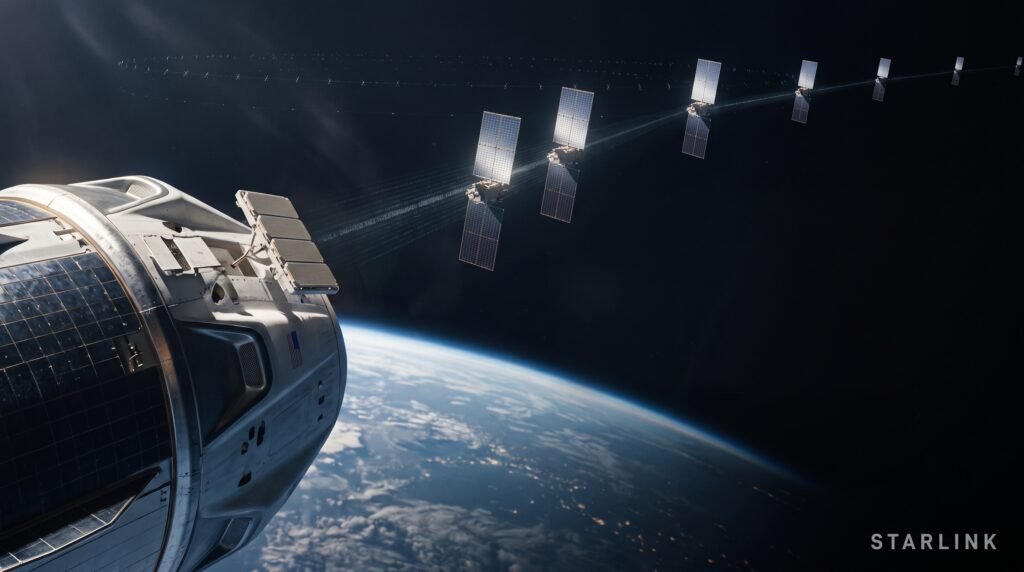
Relating on Starlink Network
Starlink is a global satellite internet network created by the aerospace company SpaceX. Instead of using cables buried in the ground or relying on cell towers, it uses thousands of small satellites flying close to our planet in low Earth orbit. And Starlink satellites are the primary choice for this kind of live broadcast because they fly in low Earth orbit. Because these satellites sit much closer to our planet than older geostationary satellites, data travels with very low delay. Low delay is essential for a live internet stream where real-time video flow matters.
However, a standard Starlink dish designed for a rooftop will not work on a spacecraft. Consumer dishes point upward toward the sky from the surface of Earth. In orbit, the capsule moves around the same altitude as the satellite network. The spacecraft must carry a custom phased-array antenna that can steer its radio beam electronically without any moving parts.
The network also relies heavily on space lasers to route the live video. When the broadcast vehicle beams video data to a nearby satellite, that satellite can pass the data across the constellation using laser beams. This inter-satellite link sends the data packets quickly around the globe until they find an Earth ground station close to the video distribution servers.
If the stream takes place on a commercial capsule like SpaceX Dragon, the craft already carries integrated satellite transmitters built into the hull. The streamer simply connects their camera feed directly into the onboard communications system rather than setting up separate hardware. This direct connection offers high data bandwidth and ensures the broadcast stays stable throughout the flight.
Well, i dont understand that, can i have example?
Imagine you want to send a letter across a huge city while riding on an extremely fast train. On regular streets, you can easily hand that letter to a friend standing right on the sidewalk. That is how normal mobile internet works because cell towers stand close to you on the ground.
In space, there is no sidewalk and no ground under your feet. The spaceship moves so high and so fast that it cannot reach those ground towers. To solve this, you need a team of friends floating high in the sky above you. These sky helpers are the satellites.
The spaceship shoots the video data up to the nearest satellite like tossing a ball into the air. If that satellite is far from your hometown, it does not drop the ball. It quickly passes the ball to another satellite across the sky using a silent laser beam. They keep passing the video from one satellite to the next until it reaches a helper floating directly over the base station.
Finally, that last satellite beams the video straight down to a receiver dish on Earth. The dish pushes the signal into the internet and directly onto your phone screen. Even though the video travels this huge relay path across the sky, the whole pass takes less than two seconds.