
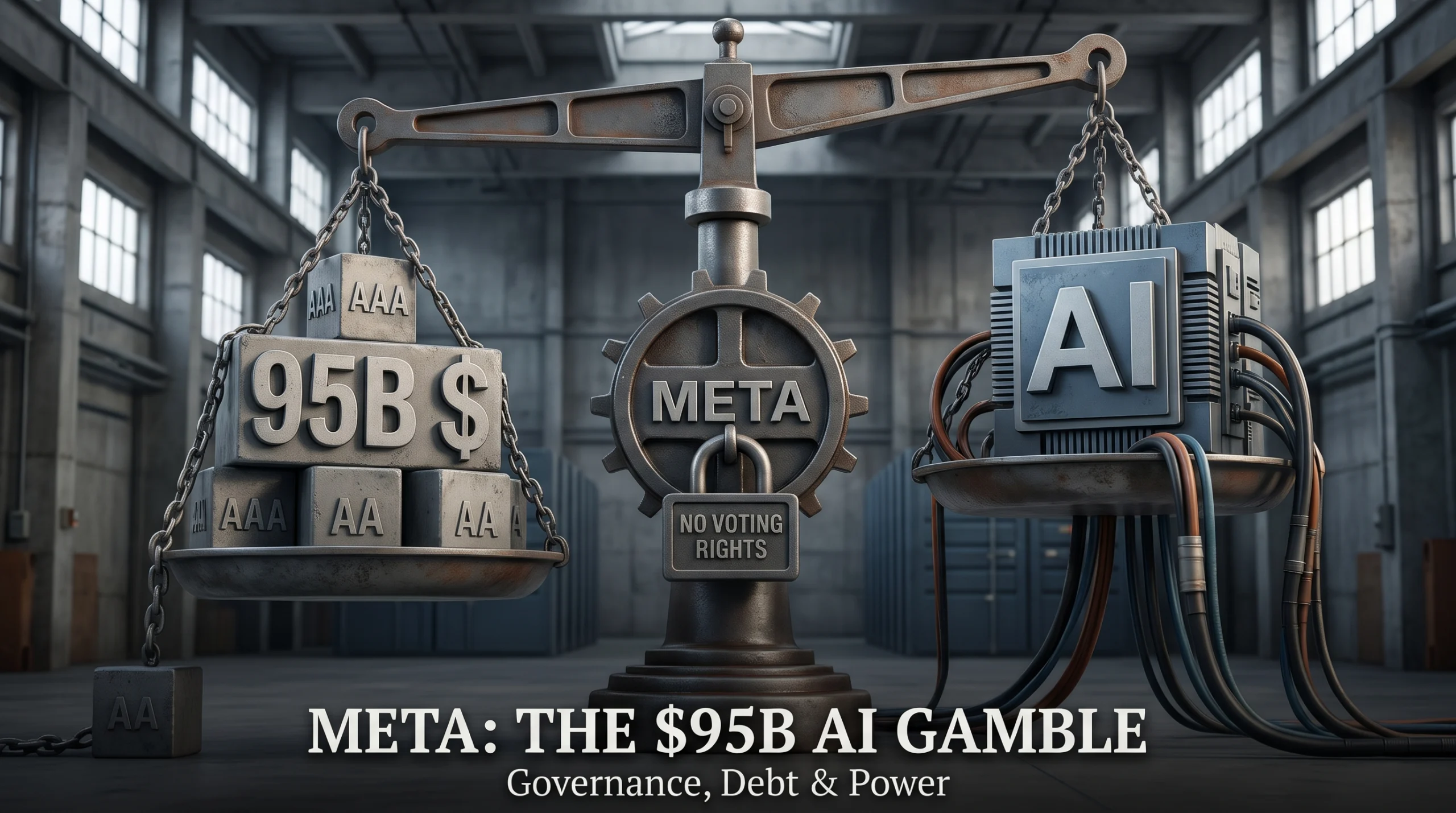
Social media leader Meta Platforms unveiled plans to raise up to ninety five billion dollars through one of the largest public equity offerings in financial market history. Headline financial articles focused primarily on the enormous dollar sum destined for specialized hardware and power generation. However, the true significance of the offering lies in the corporate governance structure of non voting shares and rating agency pressures on tech balance sheets (from bloomberg.com).
Protecting Executive Voting Control with Class C Shares
A central feature of the financing plan is the extensive use of non voting Class C equity. Out of the ninety five billion dollar total, sixty billion dollars will be raised gradually through an at the market offering program. An at the market offering is a method where a public corporation issues newly created shares directly into the secondary market at prevailing trading prices over an extended period. By issuing non voting shares rather than voting equity, corporate founder Mark Zuckerberg preserves his majority voting control over the corporation while simultaneously collecting tens of billions of dollars from public capital markets.
Credit Rating Pressures and the Shift Away from Debt
Major credit rating agencies, including Standard and Poor Global, recently shifted Meta corporate credit outlook to negative due to surging capital outlays. Issuing conventional corporate bonds at this scale would have led to an immediate downgrade into lower credit tiers, dramatically increasing annual interest expenses across existing corporate loans. Rather than straining corporate debt ratios, management turned to public equity markets. Selling equity allows the company to secure liquid capital without taking on binding debt service obligations or fixed interest repayment dates.
Frontier Model Training Costs Exceed Advertising Cash Flow
Meta operates one of the most profitable digital advertising networks in global commerce, producing massive annual revenue streams. However, training next generation conversational agent architectures such as Muse and foundation models like Muse Wonder requires tens of gigawatts of electricity and hundreds of thousands of interconnected processing units. These frontier artificial intelligence initiatives require so much capital that even record breaking ad profits cannot entirely fund them. Moving beyond internal cash flow proves that building frontier models is now a capital intensive physical engineering challenge.
The Capital Crowding Out Effect on Smaller Enterprises
When a single corporate giant absorbs ninety five billion dollars in equity investment, it creates a powerful crowding out effect across broader financial markets. A crowding out effect occurs when massive funding requirements from dominant entities consume available institutional liquidity, leaving less capital for initial public offerings and mid tier enterprises. Institutional investment funds must reallocate existing cash reserves to participate in mega cap offerings, reducing support for emerging innovators. Investors should review how large equity dilution events impact their overall shareholding percentages.