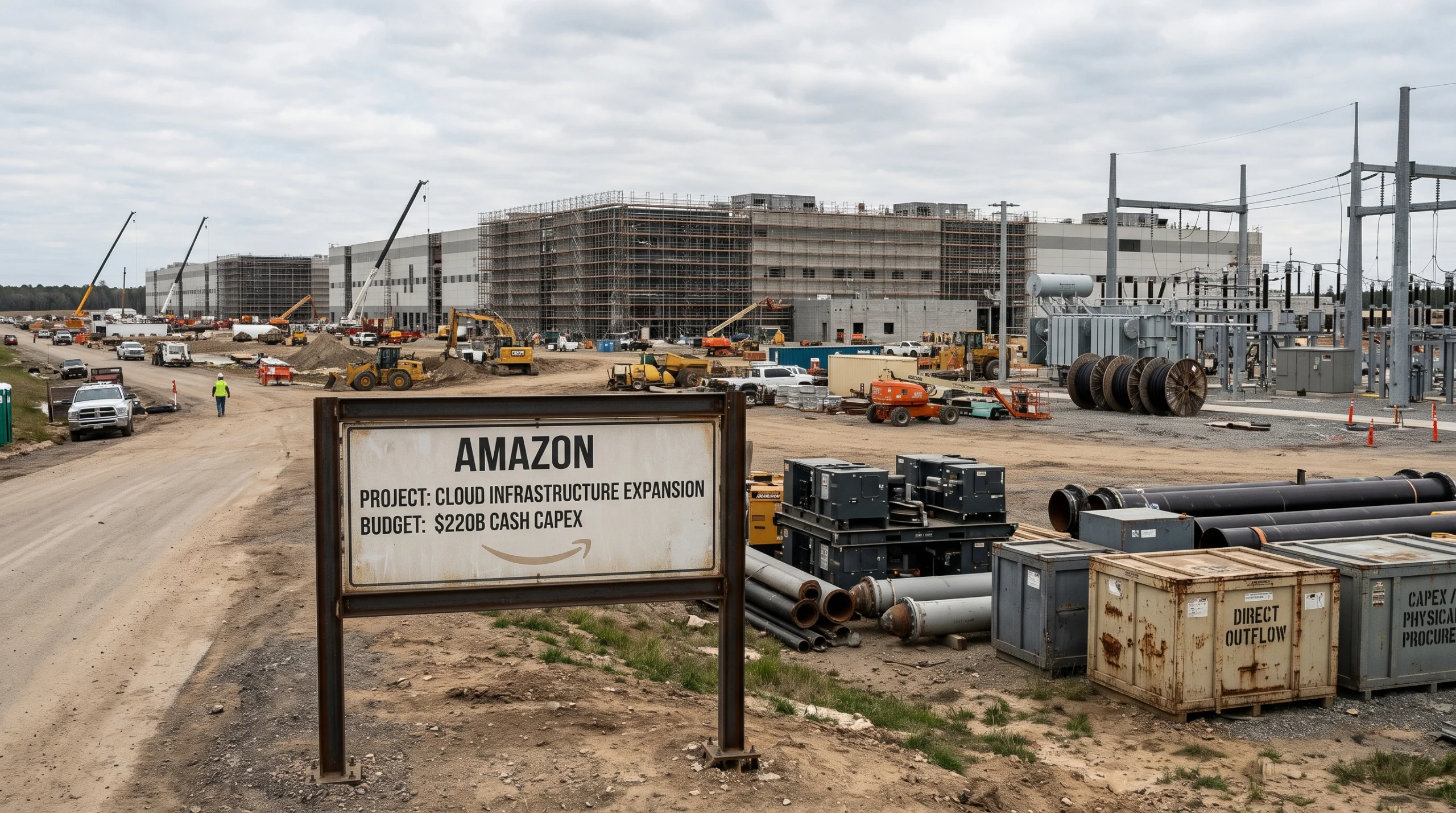
E commerce and cloud computing powerhouse Amazon announced plans to allocate two hundred twenty billion dollars toward cash capital expenditures throughout 2026, with even higher expenditures projected for 2027. Most market observers reacted solely to the sheer scale of the investment total. However, the specific accounting designation of cash capital expenditure signals a profound structural shift in corporate cash flow dynamics and internal subsidy relationships across Amazon business units (from wsj.com).
Cash Outflows Replace Equipment Leases
Historically, Amazon financed substantial portions of its computational hardware and data center equipment through multiyear equipment lease contracts. Under equipment lease arrangements, cash outflows are distributed across multiple fiscal quarters. Today, suppliers of cutting edge compute silicon, high voltage transformers, and specialized nuclear power capacity demand direct upfront cash payments before manufacturing begins. Allocating two hundred twenty billion dollars in direct cash leaves virtually no flexibility for accounting deferrals, requiring Amazon to channel almost all operating cash receipts directly into physical infrastructure procurement.
Retail Earnings Subsidize Cloud Infrastructure
For more than a decade, Amazon Web Services generated massive operating profits that funded the ongoing expansion of the global retail shipping and warehouse network. In an extraordinary historical reversal, low margin retail operations and advertising units are now providing the vital liquidity required to sustain cloud expansion. As cloud computing customers consume unprecedented compute power, third party seller commissions and consumer retail profits are actively diverted to fund electrical grid connections and server facilities for enterprise cloud tenants.
Power Grid Demands and Equipment Scarcity
A substantial share of capital spending is directed toward utility electrical substations, gas turbine generators, and long term power purchase agreements with nuclear facilities. A power purchase agreement is a legally binding contract in which an electricity buyer guarantees to purchase power directly from an energy generator at a predetermined price over decades. As hyperscale cloud providers secure private power generators, regional public electric utilities encounter severe equipment bottlenecks. Lead times for high voltage transmission transformers have stretched to several years, creating upward pressure on retail electricity rates in dense data center regions.
In House Silicon Development
To reduce reliance on expensive merchant processors, Amazon is investing heavily in its custom silicon programs, specifically Trainium and Inferentia chip designs. Deploying proprietary silicon reduces long term hardware acquisition expenses and optimizes energy efficiency per computational workload. By establishing an independent silicon pipeline, Amazon aims to protect gross margins while providing cost competitive reasoning capacity to corporate software developers.
The Rising Barrier to Foundation Infrastructure
Annual capital requirements exceeding two hundred billion dollars create an insurmountable barrier to entry for prospective competitors. Even sovereign states and venture funded consortiums cannot commit comparable funds to physical facilities year after year. As a result, foundational computing capacity is concentrating within an entrenched oligopoly of three global cloud giants. Enterprise technology leaders should audit multi cloud architectures to ensure their software applications remain portable across distinct cloud providers.